
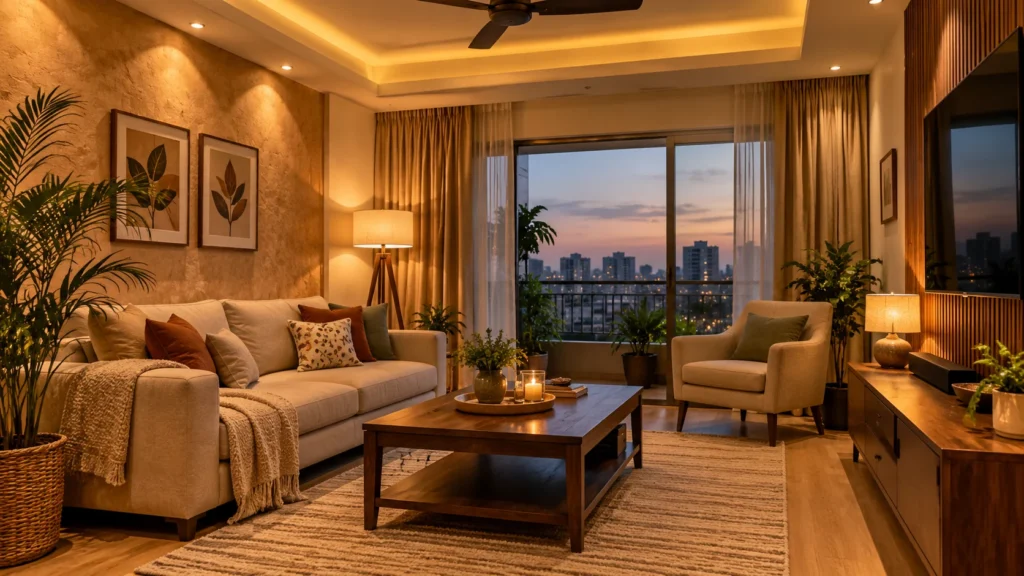
Light is the one part of an interior that every other part depends on. A well-chosen sofa looks flat under harsh white light, a good kitchen is tiring to work in if the counter sits in shadow, and an expensive office fit-out feels cold if the lighting causes glare on every screen. Good lighting design for homes and offices is not about choosing attractive fixtures. It is about deciding how much light each task needs, where it should come from and what it should feel like, and then choosing fittings to deliver that.
This guide explains the basic terms in plain language, introduces the layered approach that most good lighting plans follow, and then applies it room by room, first for homes and then for offices. It also covers fixtures, controls, planning, budgets and common mistakes.
The Basics: Lux, Colour Temperature and Colour Rendering
A few terms come up in every lighting conversation, and they are easier than they sound.
Lux measures how much light falls on a surface. It matters more than the wattage or the number of lights, because it describes what a person doing a task actually receives. The Bureau of Indian Standards code for interior illumination, IS 3646, lists 300 to 500 lux for general office work. That range is a useful benchmark for desks, study tables and any place where people read or write for long periods.
Colour temperature describes whether light looks warm or cool and is measured in kelvin. Lower values, around 2700 to 3000 K, give a warm, yellowish light that suits bedrooms, living rooms and dining areas. Values around 3500 to 4000 K give a neutral white that suits kitchens, workspaces and bathrooms. Values of 5000 K and above look bluish and crisp, and they are rarely comfortable in homes.
Colour rendering index (CRI) measures how faithfully a light shows colours. A CRI of 80 or above is a common benchmark for homes and offices, and higher values help in places where colour matters, such as wardrobes, dressing areas and retail displays. Cheap lamps with a low CRI make skin tones, food and fabrics look dull.
Glare is excess brightness that causes discomfort, and it is one of the most common lighting complaints in offices. It comes from bare bright sources in the line of sight, from reflections on screens and from strong contrast between a bright window and a dark room.
The Three Layers of a Good Lighting Plan
Most well-lit rooms use three layers, working together.
Ambient lighting provides general, even illumination for the whole room. It comes from ceiling lights, panels, cove lighting or wall washers, and it lets people move around comfortably.
Task lighting puts focused light where a specific activity happens, such as a kitchen counter, a study desk, a vanity mirror or a bedside reading area. Task light should be bright enough for the work and positioned to avoid casting shadows over the working hand.
Accent lighting highlights features such as artwork, textured walls, shelves and plants. It adds depth and a sense of design, and it is the layer that most often gets left out.
A single central light provides ambient lighting at best, and in most rooms it leaves shadows and a flat look. Layered lighting, with separate switching for each layer, lets a room change from bright and functional to soft and relaxed.
Lighting Design for Homes
Living room
The living room needs to serve many moods, from bright family time to a quiet evening. Ravo Interior’s living room design guide for Bhopal homes recommends a layered approach with ambient ceiling lighting, cove lighting hidden in the false ceiling and accent lighting on the feature wall. Add a floor lamp or table lamp beside the main seating for reading, and put each layer on its own switch or dimmer so the room can shift mood easily.
Warm white, around 2700 to 3000 K, usually works best here. Avoid placing spotlights directly above seating, because they create harsh shadows on faces. Aim accent lights at the wall or artwork instead.
Kitchen
The kitchen is a working room, and the most common mistake is relying on ceiling lights alone, which puts the person at the counter in their own shadow. Plan general ceiling light for the room and under-cabinet task lights along the counter and hob. Neutral white, around 3500 to 4000 K, helps food look natural and makes cutting and cooking easier. Ravo Interior’s modular kitchen design ideas for Bhopal homes list poor lighting among the common kitchen mistakes, which matches what most homeowners find after moving in.
Bedroom
Bedrooms need soft light, with options for brighter light when needed. Ravo Interior’s bedroom design guide for Bhopal homes suggests using warm white LED panels, a central ceiling fixture or cove lighting as the main source, and adding bedside lamps. Keep the main light dimmable, and put switches for the ceiling light at both the door and the bed so you do not need to get up to turn it off.
Avoid placing a bright light directly over the bed where it shines into the eyes of someone lying down. Reading lights should be directional so that one person can read without waking the other.
Bathroom
Bathrooms need bright, even light around the mirror, with light falling on the face from the sides or front instead of from directly above, which casts shadows. Vertical lights on either side of the mirror or a lit mirror work well. Use neutral or warm white with a good CRI. Fittings near water should have an appropriate ingress protection rating, and your electrician should confirm what suits each zone of the bathroom.
Study and home office
A study desk needs steady, glare-free light. Combine even ceiling light with a task lamp on the side opposite the writing hand, so the hand does not shadow the page. The 300 to 500 lux range for general office work is a sensible reference for sustained reading and writing at home. Place the desk so that daylight comes from the side, and avoid sitting with a bright window directly behind a screen.
Pooja room
A pooja space benefits from soft, warm light with a gentle focus on the idols. Use a low-glare spotlight or a concealed strip for the main focus, and keep the surrounding light calm. Keep wiring and fittings away from any open flame and from heat and smoke.
Entrance, corridors and staircases
These are the areas where safety matters most. Light the entrance clearly so that keys, locks and steps are easy to see. Corridors and staircases need even, glare-free light with no dark patches, and a night light or low-level light helps in households with children or older members.
Lighting Design for Offices
Offices have a different aim from homes. The light must support concentration, reduce eye strain and suit tasks that last hours, while still creating an environment that looks professional.
Open workstation areas
The main working floor needs even, glare-free light at roughly the 300 to 500 lux range given in IS 3646 for general office work. Use a regular pattern of ceiling panels or downlights, and avoid placing bright bare sources in the line of sight. Position monitors so that neither windows nor ceiling lights reflect in them. Desks that run parallel to windows, with blinds for control, usually give better results than desks that face directly into bright glass.
Ravo Interior’s guide to designing a productive staff area for a Bhopal office includes a section on lighting design for staff areas, alongside acoustics and workstation planning, which reflects how closely these concerns are linked in a working office.
Colour temperature affects mood and alertness as well. Neutral white in the 3500 to 4000 K range suits most workspaces. Very cool light can feel harsh by evening, and very warm light can feel sleepy at midday.
Executive cabins and video calls
Cabins need good task light at the desk and softer, more welcoming light in any seating area. Ravo Interior’s executive cabin design guide for Bhopal offices advises keeping the meeting area light warm and inviting instead of task-oriented, with a pendant over the table or wall lights beside the seating, and it recommends planning the desk position and lighting with video calls in mind. For calls, light should fall on the face from the front or side, with no strong light behind the speaker.
Meeting rooms
Meeting rooms need flexibility. A room used for presentations, discussions and video calls needs bright, even light for some uses and dimmed light for screens. Ravo Interior’s meeting room design ideas for Bhopal offices include a section on meeting room lighting design and the different lighting scenes a room needs, and the practical takeaway is the same as at home: separate circuits and dimmers so one room can serve several purposes.
Reception and waiting areas
Reception is where a visitor’s impression forms. Light the desk well so staff can work comfortably, add soft accent light on a feature wall or logo area, and keep the waiting area warmer and more relaxed than the working floor. Make sure the entrance is clearly visible from outside.
Daylight and glare control
Daylight is valuable and free, but uncontrolled it creates glare and heat. Use blinds or light-filtering curtains, place workstations to use the daylight without facing into it, and use glass partitions so that cabins and meeting rooms share light with the main floor. In the summer, shading also reduces the cooling load.
Choosing Fixtures and Controls
Downlights and panels give even ambient light in offices and most homes. Choose a beam angle and spacing that avoid bright spots and dark gaps.
Cove and strip lighting provides a soft, indirect glow and works well in living rooms, bedrooms and reception areas. Use quality strips and drivers, and leave the cove accessible so that failed parts can be replaced.
Track and spotlights suit accent lighting on walls, artwork and displays, and they can be adjusted later.
Pendants and decorative lights add character over dining tables, in meeting areas and at entrances. Check that their light is comfortable and not just decorative.
Task lamps and under-cabinet lights provide the focused layer that ceiling lights cannot.
Controls matter as much as fixtures. Group lights into separate circuits for each layer, add dimmers where mood or flexibility matters, and place switches where people naturally reach for them. Smart controls and scenes are useful in larger homes and in offices, but they are an addition to a good basic plan, not a substitute for one.
Quality also shows in drivers and LED chips. Choose flicker-free products with a decent CRI from reliable suppliers, and ensure that drivers and strips have ventilation, since heat shortens their life.
Planning Lighting Before the Ceiling Is Built
Lighting is best planned alongside the layout, before false ceilings, wiring and furniture positions are fixed. Once the ceiling is closed, adding points is costly and messy. A good lighting plan marks each fixture, its type, its circuit and its switch, and it is drawn against the furniture layout so that task lights sit where the work happens.
| Space | Ambient | Task | Accent | Suggested colour temperature |
| Living room | Cove or ceiling lights | Reading lamp | Wall or artwork lights | Warm, 2700 to 3000 K |
| Kitchen | Ceiling panels | Under-cabinet strips | Optional shelf lighting | Neutral, 3500 to 4000 K |
| Bedroom | Dimmable ceiling or cove | Bedside reading lights | Headboard wall light | Warm, 2700 to 3000 K |
| Bathroom | Ceiling light | Mirror lighting | Optional niche light | Neutral to warm, 3000 to 4000 K |
| Study | Ceiling light | Desk lamp | Shelf light | Neutral, 3500 to 4000 K |
| Office floor | Even ceiling panels | Desk lamps where needed | Feature wall | Neutral, 3500 to 4000 K |
| Meeting room | Dimmable ceiling light | Table or pendant light | Wall light | Neutral, adjustable |
Lighting on a Budget
Lighting is usually a small part of an interior budget, but it has a large effect on how the finished space feels. Ravo Interior’s interior design cost guide for Bhopal says that good lighting changes a space more than almost any other single element, and that the gap in cost between basic and good lighting is often small compared with the overall project. Spend where light is used daily, such as the kitchen counter, study desk and working floor, and save on decorative pieces that can be added later.
Compare quotations by what they include. Ask how many points, what type of fixture, what brand and quality of drivers and strips, and whether dimmers and control gear are included.
Common Lighting Mistakes
Relying on one central light. It leaves shadows and a flat look.
Choosing fixtures before planning points. Points fixed in the ceiling decide what is possible later.
Mixing colour temperatures carelessly. Warm and cool light in the same room looks uneven unless it is deliberate.
Ignoring glare. Bare bright sources and screen reflections cause fatigue in offices and studies.
Skipping dimmers. Rooms that serve several purposes need adjustable light.
Buying poor quality LEDs. Flicker, low CRI and early failure spoil the whole room.
Placing switches badly. If switches are hard to reach, people leave lights on or use only one.
Working With a Designer on Lighting
Lighting is easiest to get right when it is part of the original design, not added at the end. Ravo Interior is an interior design firm based in M.P. Nagar, Bhopal, and its website states that it serves clients across Bhopal. Its residential interior design services cover living rooms, bedrooms, kitchens, bathrooms and pooja rooms, and its corporate office interior design page lists cabins, meeting rooms, staff areas and cafeterias. The site describes a four-step process of consultation, 3D design, in-house production and installation, and states 200+ completed projects and a team of 50+.
If your property is outside Bhopal, confirm availability for the exact location at the first conversation. Before hiring any designer, ask to see a lighting plan with circuits and switching, not just a list of fixtures, and ask how dimming and zoning will work. The contact page has the details for getting in touch.
Frequently Asked Questions
How many lights does a room need?
There is no fixed number. It depends on the room size, the ceiling height, the tasks and the fixtures chosen. A designer or electrician can calculate it, using lux targets for the main activities.
What colour temperature is best for a home?
Warm white, around 2700 to 3000 K, suits bedrooms, living rooms and dining areas, and neutral white, around 3500 to 4000 K, suits kitchens, bathrooms and study areas. Very cool light is rarely comfortable at home.
What lighting level is recommended for an office?
IS 3646, the Bureau of Indian Standards code for interior illumination, lists 300 to 500 lux for general office work. Detailed tasks need more light, and a lighting designer can calculate it for each area.
Are LED cove lights worth it?
They add a soft, indirect layer that suits living rooms, bedrooms and reception areas. They work best with good quality strips and drivers, proper ventilation and access for maintenance.
Do I need dimmers?
In rooms that serve several purposes, such as living rooms, bedrooms and meeting rooms, dimmers add real value. In utility spaces, they are less important.
Plan the Light, Then Choose the Fixtures
Good lighting follows a simple order. Decide what each space is used for, work out how much light and what kind each task needs, plan the layers and circuits, and only then choose the fixtures. Done this way, lighting makes rooms easier to use, easier on the eyes and more pleasant to be in, for homes and offices alike.
If you are planning a new interior or a renovation and want a proper lighting plan, explore the work listed on the Ravo Interior website or talk to the team about your project. For more planning advice, the interior design articles on the Ravo blog are a useful next read.