
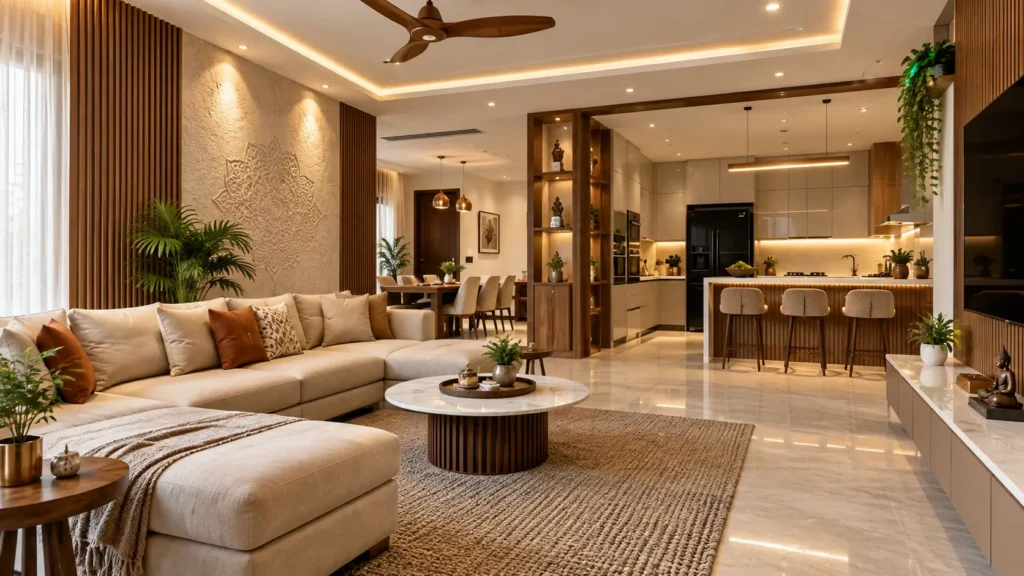
When people search for interior design in Bhopal, they are not always planning a project inside the city itself. Homeowners and business owners in the surrounding region may also look toward Bhopal when they want design guidance, detailed planning, material selection, visualization, or a complete interior execution partner. Bhopal sits within a wider regional network that includes Sehore, Raisen and Vidisha, with the official Bhopal district administration identifying Vidisha to the northeast, Raisen to the east and southeast, and Sehore to the south and southwest.
That regional connection makes Bhopal an important reference point for people comparing interior design options. At the same time, a project located outside Bhopal needs a more careful approach. Travel, site visits, execution supervision, material logistics and project management can all depend on the exact location and scope of work.
Ravo Interior is a Bhopal-based interior design and execution company that works across residential, commercial and corporate interiors. Its current website describes services ranging from home interiors and modular kitchens to office design, custom furnishing, commercial spaces and corporate interiors.
This guide explains how to think about interior design for homes and businesses in Bhopal and nearby areas, including Sehore, Raisen and Vidisha, while also helping you understand what should be planned before selecting an interior designer.
Why Bhopal Matters When Planning an Interior Project
Bhopal is not only a city where people live and run businesses. It is also part of the administrative Bhopal Division, which includes Bhopal, Raisen, Sehore and Vidisha among its districts.
For interior design customers, the important point is not simply geography. It is accessibility to design expertise, material suppliers, project teams and execution support.
A homeowner in a developing residential area may need a completely different solution from the owner of a retail shop or office. A two-bedroom apartment might require careful storage planning and a compact kitchen layout. A commercial space may need customer circulation, brand visibility and durable finishes. An office may need workstations, meeting rooms, storage, reception space and infrastructure planning.
The best interior project therefore starts with the function of the space rather than a collection of attractive photographs saved from social media.
Residential Interior Design Around Bhopal
Residential interiors need to work with everyday life.
The website of Ravo Interior describes residential projects across living rooms, bedrooms, bathrooms, kitchens, study rooms, balconies, pooja rooms, home offices, home theatres and other areas of the home. It also describes the residential design process as covering space planning, material selection, design development and execution.
That broad approach matters because a home rarely has just one design problem.
A living room might need better seating, storage and lighting. A bedroom may need wardrobe capacity without making the room feel cramped. A kitchen may require better workflow and more accessible storage. A balcony may be small but still need to function as a useful part of the home.
Living Room Design
The living room often becomes the visual centre of a home. But visual appeal should not come at the cost of movement and comfort.
Before choosing furniture, consider:
- Available floor space
- Seating requirements
- Television and media placement
- Storage needs
- Natural light
- Electrical points
- Window and door positions
- Cleaning and maintenance
A smaller room can benefit from appropriately sized furniture and carefully planned storage rather than simply adding decorative pieces.
For larger homes, the challenge can be the opposite. An oversized room can feel disconnected when furniture, lighting and finishes are chosen independently. Good interior planning creates visual relationships between the different parts of the room.
Bedroom Interior Planning
Bedrooms need a balance between storage, comfort and visual calm.
Wardrobes should be planned around actual storage requirements. Bed placement should consider circulation and access. Lighting should not rely on a single bright ceiling fixture when softer layers can provide greater flexibility.
The same thinking becomes particularly important in family homes where different bedrooms may serve completely different users.
Modular Kitchen Design
The kitchen is one of the areas where detailed planning has a direct effect on daily use.
Ravo Interior’s residential service page describes modular kitchen planning around kitchen layout, workflow and storage requirements, with options including parallel, L-shaped and island configurations depending on space.
A kitchen design should therefore begin with questions such as:
What is the available wall length?
Where are water, drainage and electrical connections?
How much storage is required?
What appliances will be used regularly?
Which items need easy access?
How much counter space is actually needed?
A visually attractive kitchen that is difficult to work in becomes frustrating very quickly.
Bathrooms and Smaller Spaces
Smaller rooms often require more planning, not less.
Bathroom interiors need to balance fixtures, storage, movement, ventilation, lighting and finish selection. Similar principles apply to balconies, compact studies and narrow passage areas.
Instead of trying to make every room look dramatic, the better objective is to make every square foot useful.
Commercial Interior Design Around Bhopal
Commercial interiors operate differently from residential spaces because the design needs to support a business.
Ravo Interior’s commercial services cover spaces such as offices, retail shops, banquet halls, receptions and lounges, while its broader commercial offering also includes restaurants, hotels, resorts, salons, showrooms and similar business environments.
A business owner should therefore evaluate design decisions from both the customer and operational perspective.
Retail Shops and Showrooms
A retail interior needs clear circulation.
Customers should be able to enter easily, understand the layout, identify important products and move around comfortably. Storage, display systems, lighting and branding should work together rather than compete for attention.
A showroom may require a stronger visual presentation, while a high-volume retail store may place greater emphasis on product accessibility and efficient movement.
The right approach depends on what the business is actually trying to achieve.
Offices
Office interiors have their own set of requirements.
The space may need:
- Reception
- Workstations
- Cabins
- Meeting rooms
- Storage
- Staff areas
- Pantry space
- Power and data planning
Ravo Interior’s office-related material emphasizes needs assessment, detailed quotations, 3D visualization, project management and site supervision as parts of its approach to office projects.
A good office is not simply a room filled with attractive furniture. Layout affects how people move, collaborate, concentrate and use shared facilities.
Restaurants, Salons and Customer-Facing Spaces
Customer-facing businesses depend heavily on experience.
A salon needs practical station placement, mirrors, lighting and storage. A restaurant needs appropriate circulation, seating, service movement and a visual identity that fits the concept. A hotel or resort has additional guest-experience requirements.
The interior should support the business model.
That is why copying a design from another city can produce disappointing results. The same layout may work beautifully for one business and poorly for another because the available area, customer profile, operating model and budget are different.
What Changes When Your Project Is in Sehore, Raisen or Vidisha?
This is where location-specific planning becomes important.
Official district information confirms that Bhopal shares boundaries with Sehore and Raisen and is bordered by Vidisha to the northeast. Raisen itself is bordered by Sehore to the west and Vidisha to the north.
For a client planning an interior project in one of these areas, the first question should not simply be, “Can I hire a Bhopal designer?”
A better question is:
Can the designer practically support my project at its exact location?
That requires checking several things before signing an agreement.
1. Site Visit Availability
Interior design depends heavily on the physical site.
Measurements, wall conditions, ceiling heights, electrical points, plumbing locations, doors, windows and existing construction all influence the design.
For an out-of-city or out-of-office-area project, confirm whether the designer will visit the site and how frequently site supervision will happen.
2. Project Radius and Service Area
This is especially important for Ravo Interior.
Its current website states that the company serves residential, commercial and corporate clients across Bhopal and within a 15-kilometre radius of the city.
That means customers in Sehore, Raisen or Vidisha should not automatically assume that their property falls within the stated service area. The practical availability of a project should be confirmed based on the property’s exact location.
This is an important distinction between writing a regional guide and making a service claim.
3. Material and Logistics Planning
Projects outside the designer’s main city can require additional coordination for transport, delivery and installation.
Before work begins, clarify:
Who purchases the materials?
Who receives deliveries?
Who checks material quality?
Who handles installation?
Who supervises carpentry or fabrication?
How are changes communicated?
The answers should be clear before execution starts.
4. Communication During Execution
Distance becomes less of a problem when the workflow is well documented.
Drawings, 3D views, measurements, material specifications, quotation details and approval records should be organized so that decisions do not depend entirely on informal phone conversations.
Ravo Interior describes its process as progressing from consultation to design, production and installation, with 3D concepts used before execution moves forward.
How to Plan a Home Interior Project in Sehore, Raisen or Vidisha
A regional residential project can be managed more smoothly when planning begins early.
Start with a basic project brief.
Write down the property type, number of rooms, people who will use the home, storage requirements, preferred style and approximate investment range.
Then separate your requirements into three groups.
Must have: things the home genuinely needs.
Useful to have: features that improve convenience but can be adjusted.
Optional: decorative or premium additions that can be considered after essential requirements are covered.
This simple distinction can make budget discussions much easier.
Think About the Entire Home
One common mistake is to design room by room without considering the home as a whole.
The flooring, wall colours, wood finishes, lighting temperature and furniture style should have some visual relationship.
That does not mean every room must look identical.
A bedroom can be softer than the living room. A child’s room can be more expressive. A pooja room can have a distinct visual identity.
The goal is continuity, not repetition.
How to Plan a Business Interior in the Surrounding Region
Businesses often have tighter operational constraints than homes.
A shop may need to open quickly.
An office may need to continue functioning during renovation.
A salon may need specific plumbing, electrical and workstation arrangements.
A restaurant may have kitchen, seating and service-flow requirements that cannot be solved through decoration alone.
For these projects, create an execution checklist before approving the design.
Define the Scope
Clarify exactly what the designer is handling.
Does the scope include only design?
Does it include furniture?
Does it include false ceiling work?
Does it include electrical changes?
Does it include plumbing?
Does it include fabrication?
Does it include painting?
Does it include final installation?
A clear scope helps prevent misunderstandings later.
Confirm the Quotation
Ravo Interior’s website emphasizes detailed quotations and transparent pricing in its process and service material.
Clients should still review every quotation carefully.
Look for:
- Material specifications
- Quantities
- Finish details
- Furniture inclusions
- Labour
- Installation
- Electrical work
- Civil work
- Delivery
- Taxes, where applicable
- Payment schedule
- Exclusions
A low headline number does not necessarily represent a lower total project cost if important work has been excluded.
Why 3D Visualization Can Help Before Execution
It is often difficult for a client to imagine the finished room from a floor plan alone.
Ravo Interior states that its designers create detailed 3D concepts so clients can visualize the proposed space before execution begins.
For homeowners and business owners, this can make design decisions easier.
You can review questions such as:
Does the furniture feel too large?
Is the storage sufficient?
Does the colour combination feel right?
Does the lighting support the intended mood?
Does the reception area look appropriately professional?
Does the kitchen provide enough usable counter space?
The earlier these questions are answered, the easier it is to avoid unnecessary changes during execution.
Common Interior Design Mistakes to Avoid
Choosing Looks Before Layout
A beautiful reference image is not proof that the same design will suit your space.
First solve the layout. Then decide the finishes and decorative details.
Ignoring Storage
Storage is one of the most important practical parts of a home.
Open shelves, wardrobes, overhead cabinets, drawers and utility storage should be planned according to the actual lifestyle of the users.
Underestimating Electrical Planning
Sockets, appliances, lighting, television points, networking and equipment should be considered before the final execution stage.
Changing electrical positions after furniture and finishes are installed can create unnecessary work.
Making Every Surface Decorative
Not every wall needs a feature treatment.
Too many competing elements can make a room look busy and make future changes harder.
Choosing Materials Without Understanding Maintenance
A finish may look excellent in a photograph but require more maintenance than the owner is prepared to provide.
Think about cleaning, moisture, everyday wear, repairs and long-term practicality.
How to Choose an Interior Designer for a Regional Project
Whether your project is in Bhopal, Sehore, Raisen or Vidisha, the selection process should go beyond the portfolio.
Ask to understand the actual workflow.
Review Relevant Projects
Look for projects similar to yours in size, type and complexity.
A designer known mainly for luxury villas may not necessarily be the best choice for a compact office, just as a commercial specialist may not be ideal for a highly personalized family home.
Understand Who Manages Execution
A project can involve designers, contractors, fabricators, electricians, plumbers and other specialists.
Ask who coordinates them.
Ravo Interior describes its workflow as including consultation, design, production and installation, with material procurement and execution handled as part of its project process.
Ask About Approvals
Before production begins, know what you are approving.
Ideally, major decisions around layout, materials, finishes and design should be reviewed before fabrication or installation.
Check the Exact Project Location
This is particularly important for customers outside Bhopal.
Do not rely on the general phrase “around Bhopal.”
Share the exact property location and ask whether the project falls within the designer’s current service area.
For Ravo Interior, the website currently specifies Bhopal and a 15-kilometre service radius, so this verification should happen before any outside-area project is discussed as confirmed.
Interior Design in Bhopal With a Practical Regional Approach
Good design does not depend only on trends.
It starts with understanding the people, the property and the way the space will actually be used.
For a home, that can mean better storage, a practical kitchen, comfortable bedrooms and lighting that works throughout the day.
For a business, it can mean a clear customer journey, a functional workspace, better presentation and an environment that supports daily operations.
For customers in Sehore, Raisen and Vidisha, there is one additional factor to consider: execution practicality. A designer may be based in Bhopal, but the exact property location, service radius and supervision arrangement should be confirmed before the project begins.
That approach protects both sides and makes it easier to plan realistically.
Frequently Asked Questions
Is Ravo Interior available for projects in Sehore, Raisen and Vidisha?
Ravo Interior’s current website states that it serves Bhopal and clients within a 15-kilometre radius of the city.
Because Sehore, Raisen and Vidisha cover areas outside Bhopal, project eligibility should be confirmed using the exact property location rather than assuming the entire district or city is covered.
What types of residential interiors does Ravo Interior provide?
Ravo Interior lists residential design for living rooms, bathrooms, bedrooms, study rooms, balconies, kitchens, pooja rooms, home offices, home theatres and elevations.
Does Ravo Interior handle commercial and office interiors?
Yes. The company’s current website lists commercial and corporate services, including offices, retail shops, showrooms and other commercial environments.
Is 3D interior design visualization available?
Ravo Interior states that its design process includes detailed 3D concepts to help clients visualize the space before execution.
What should I prepare before contacting an interior designer?
Start with the property location, floor plan if available, room dimensions, photos of the current space, basic requirements, preferred style and an approximate budget range.
For commercial spaces, also prepare information about your business type, customer flow, staff requirements and operational needs.
Should homeowners outside Bhopal choose a local interior designer instead?
Not necessarily. The better question is whether the designer can practically support the project.
Compare service area, site visits, supervision, execution capability, communication process, portfolio, quotation clarity and material coordination before deciding.
Final Thoughts
Interior design for homes and businesses around Bhopal requires more than picking attractive furniture, colours or finishes.
It requires a clear understanding of the property, the people using it, the business purpose where applicable, the available budget and the realities of execution.
Bhopal’s position within the surrounding regional area makes it a natural design reference for projects connected to Sehore, Raisen and Vidisha. Official government sources confirm the geographic relationship between these districts, while Ravo Interior’s current website establishes its Bhopal base, residential and commercial design capabilities, and stated 15-kilometre service radius.
For anyone considering a project, the next step should be practical: share the exact location, define the scope, review the design approach, confirm site-support arrangements and understand what is included before execution begins.
For a Bhopal-based project, you can explore Ravo Interior’s residential and commercial interior design services and discuss your requirements with the team. For projects in Sehore, Raisen or Vidisha, confirm the exact service-area availability before proceeding.
Ravo Interior is based at Plot No. 61, 3rd Floor, Near Shree Vatika Hotel, Zone-I, M.P. Nagar, Bhopal, according to its current website.